When does IT outsourcing make sense?
IT outsourcing is now part of everyday life for many companies. Increasing demands, a shortage of skilled workers and complex technologies mean that external partners are increasingly taking on a central role. The question that arises is not only whether to outsource, but when it really makes sense and where outsourcing can become a risk. This article provides a clear overview of the opportunities and pitfalls and shows what companies should consider before outsourcing responsibility.
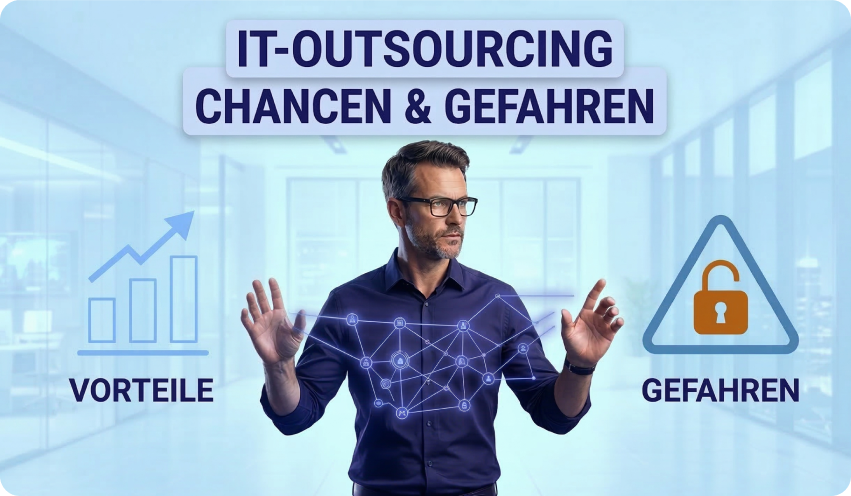
Why companies are even thinking about IT outsourcing
Many companies today are under pressure. Systems need to be stable, security requirements are increasing and digital projects need to be completed more quickly. At the same time, there is a lack of qualified specialists and internal teams are often overloaded. Outsourcing is therefore becoming a realistic option because it provides expertise, capacity and stability in the short term.
Another aspect is the growing technical breadth. Cloud infrastructure, cyber security, automation, data management and application operation can hardly be covered by a small in-house team. Companies are therefore considering whether an external partner can operate certain areas better, more securely or more cost-effectively. This is precisely where the strategic idea behind outsourcing begins: to concentrate internal resources on what really drives your own business.
The advantages of outsourcing
Outsourcing can take the pressure off companies and give them a level of flexibility that is difficult to achieve internally. The biggest advantage is quick access to specialist knowledge. An external partner brings well-established teams, clear processes and tried and tested tools. This saves time and reduces error rates. At the same time, costs can be planned better because budgets no longer depend on spontaneous staff shortages or unexpected system problems.
The advantages at a glance:
When used correctly, outsourcing ensures that IT is not blocked, but becomes an accelerator.
Typical areas of application for IT outsourcing
In practice, there are areas in which outsourcing works particularly well. These include tasks that are clearly structured, require continuous support or require specialist knowledge. Frequently outsourced topics are, for example, the operation of cloud environments, monitoring and support, cyber security, the support of standard applications or the development and maintenance of infrastructure. Recurring tasks such as patch management, backups or the onboarding of new employees can also often be handled more efficiently externally.
Companies use outsourcing primarily where routines can be cleanly automated and where external specialists react more quickly or scale more cost-effectively. At the same time, there is enough room to keep strategic decisions and business-critical know-how in-house.
Where outsourcing reaches its limits
As helpful as outsourcing can be, it is no substitute for strategic thinking in-house. Problems arise above all when companies relinquish responsibility completely and rely too much on the service provider. If you don't have a clear idea of your own requirements, you quickly become dependent or lose track of critical processes.
Another point is communication. Outsourcing only works if expectations, response times and responsibilities are clearly defined. If this foundation is lacking, gaps arise. Minor misunderstandings become real disruptions, especially when it comes to security-related issues or day-to-day operations.
Culture also plays a role. Some areas thrive on direct collaboration and short lines of communication. If too much is outsourced here, the team loses speed and knowledge is not retained internally. Outsourcing reaches its limits precisely where proximity, internal expertise and rapid coordination are crucial.
Typical risks that are often underestimated
Many risks are organizational rather than technical. They arise quietly and only become apparent when they are already hurting. The most important points can be easily divided into three core areas.
Dependence on the service provider
If a company no longer has its own overview of systems, processes and architecture, a one-sided dependency arises. Cancellations, price changes or quality problems then hit harder than expected. Without its own technical understanding, there is also no basis for controlling a service provider or changing it if necessary. As a result, the company becomes dependent in the long term and loses room for maneuver.
Unclear responsibilities
Many companies underestimate this risk because they assume that outsourcing automatically makes it clear who is responsible for what. In practice, however, gaps quickly arise if roles, processes and response times are not clearly defined. Even with SLAs, the risk remains if no one checks internally how these requirements are implemented on a day-to-day basis. This leads to delays, misunderstandings and, in an emergency, security problems.
Security and compliance problems
As soon as data leaves the company, the requirements for protection and documentation increase. Many underestimate the importance of regular audits, transparency in data access and clearly regulated interfaces. New regulations such as NIS2 also increase the obligation to monitor.
Loss of knowledge in your own team
If everything is outsourced, no internal expertise remains. This sounds banal, but it is a major risk. Companies not only lose technical understanding, but also the ability to make good strategic decisions or manage service providers sensibly.
What current figures on outsourcing really show
Current market data clearly shows how much IT outsourcing has grown. The IT Outsourcing Market Report 2024 by Mordor Intelligence estimates the global market volume for 2025 at around 618.13 billion US dollars. The market is expected to grow further by 2030, by around 19% in total. The figures clearly show how naturally companies rely on external IT services today.
The reasons range from growing technology density to a lack of skilled workers. At the same time, the trend shows that outsourcing has long been more than just a cost issue. Many companies now use external support specifically to drive innovation, meet their security requirements and implement projects more quickly.
How companies find the right balance
The best outsourcing strategy is never black and white. Successful companies make a clear distinction between tasks that run more stably externally and areas that must remain internal. A good starting point is a clear inventory.
Which systems are business-critical?
Which tasks are repeated?
Where is there a shortage of skilled workers?
Where is internal knowledge needed in order to make decisions?
Anyone who answers these questions honestly will quickly recognize which parts of IT can be sensibly outsourced.
Realistic expectation management is also important. Service providers do not act as a fire department for structural problems, but as partners. This means that processes, interfaces and responsibilities must be clearly described. Companies that use outsourcing successfully maintain a healthy mix. They hand over recurring, standardized tasks and keep strategic areas, architecture decisions and security governance in-house.
Another success factor is regular coordination. Good outsourcing models thrive on close communication, fixed contact persons and transparent KPIs. With such a setup, the company remains capable of acting while the service provider takes on the operational burden. This creates a balance that not only reduces costs, but also brings stability and speed.
When outsourcing becomes a real relief
With our Managed Cloud Service, we take on precisely those tasks that take up a lot of time on a day-to-day basis and need to run flawlessly at the same time. This includes operation, monitoring, security and regular updates. You stay in control, we ensure that everything runs smoothly.
Conclusion
IT outsourcing is neither a panacea nor a risk per se. It works best when companies take a structured approach, clearly define responsibilities and maintain a minimum level of technical understanding internally. Those who achieve this gain flexibility, stability and access to expertise that is often difficult to build up internally.
However, many companies only realize during the process how complex the decision-making process actually is. Which tasks are really suitable for outsourcing? How do you ensure that knowledge is retained internally? And what security requirements apply to your own industry?
If you are at this point or would like to review your current strategy, we will be happy to support you. We help companies to develop outsourcing models that are technically sound and sustainable in the long term.
Feel free to contact us, alternatively you can book an appointment to talk to one of our experts about IT outsourcing.
.webp?ts=1774949221)