5 misconceptions about digital sovereignty
Do you believe your infrastructure is secure? Many do – until an audit reveals how weak the foundation really is. These five misconceptions cause companies to lose control without even realising it. Recognise where the risks really lie.
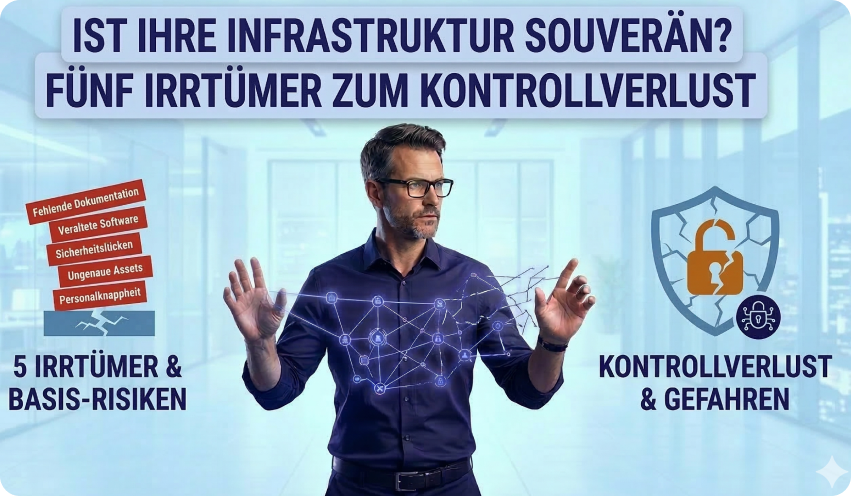
It rarely starts with a big bang. Much more often you feel a quiet crunching in the background - and don't immediately know where it's coming from. Data slips into legal spaces that you never chose. Platforms suddenly outgrow you. Technologies make decisions that should actually be your responsibility. And while all this is happening, something that is essential for every company is lost: control.
Perhaps you know this feeling. Decisions that seemed sensible a few years ago are now being scrutinized by audits, customers or new EU regulations. And suddenly a question arises that is hard to avoid:
How sovereign is our digital infrastructure really?
Digital sovereignty is not a political buzzword. For you, it is either an economic risk factor - or a strategic advantage. Depending on how clearly you set up your digital basis. But what does that mean in concrete terms?
What is digital sovereignty?
The term is now used everywhere, but real clarity is rare. A look at search queries such as "digital sovereignty definition" shows exactly that: companies are looking for guidance.
At its core, digital sovereignty refers to a company's ability to act autonomously - technologically, strategically and legally. Not dependent. Not at the mercy of others. But capable of acting.
Three levels play a decisive role here:
In short, digital sovereignty is the ability of your company to act in a self-determined manner instead of being controlled by suppliers, platforms or jurisdictions. It is a state that is not created but consciously shaped.
Where companies are unconsciously losing sovereignty today
When you read the definition of digital sovereignty, many things seem tangible: clear principles, clear responsibilities. But in practice - where cloud computing and digital sovereignty are directly linked - a company often loses control precisely where no one is looking. And this is precisely why the crucial question arises: where does sovereignty actually slip away in everyday life - and why so often unnoticed?
Many organizations are convinced that their infrastructure is sovereign. Hosting takes place "in the EU", the provider promises GDPR compliance and the contracts are clearly formulated. But reality shows that loss of control is rarely the result of a deliberate wrong decision. It is caused by technical details, standard configurations or automated processes that run in the background - and which you barely see in your day-to-day business.
Replication mechanisms
Automatic replication mechanisms in cloud or SaaS services are a classic example. A log file is mirrored to another region because the standard configuration provides for this. A diagnostic file suddenly ends up on servers outside Europe for error analysis. Or a content delivery network distributes content via nodes whose location no one has actively checked. Technically sensible, but strategically fatal if data crosses borders that you never wanted to cross.
API chains
It becomes even more critical when API chains are involved. Modern systems consist of dozens of integrated components: Payment, CRM, ERP, analytics, email marketing, ticketing. Each connection opens up new data paths.
You may be familiar with situations like this: A team introduces a useful tool to improve conversion rates. Weeks later, your IT department discovers that the tool is silently replicating customer data to a third country. No malicious vendor, no malpractice - but an architecture that is built just that way.
Vendor lock-in
And then there's the most subtle loss of control: vendor lock-in. On paper, you can switch at any time. In practice, exports are incomplete, expensive or so technically cumbersome that switching is hardly realistic. As a result, technology that is supposed to provide support becomes a de facto one-way street.
Audit
Particularly unpleasant are those moments when you only find out during an audit that an inconspicuous plugin or analysis script is sending personal data to a provider that was never on your list. Such cases may seem small, but they have a big impact - because they show how difficult it is to fully penetrate complex third-party structures.
In the end, a clear pattern emerges: companies rarely lose their digital sovereignty consciously. They lose it through many small decisions, standards, defaults and automatisms. And they often only realize it when it becomes critical - or when an auditor asks the wrong question.
Europe's response: projects, open source and political decisions
Increasing geopolitical risks, stricter EU regulations and growing cloud dependencies are no longer isolated trends. They work together - and they affect European companies at a critical point: their digital base. This is precisely why Europe has begun to create its own structures that not only enable digital independence, but actively promote it.
For years, Europe was dependent on infrastructures whose values, legal spaces and architectural principles were not fully in line with European requirements. This led to dependencies that increasingly became a problem in global competition. The continent has now drawn the necessary conclusions: Digital sovereignty should not be the result of fortunate circumstances, but a designed state.
Gaia-X
Gaia-X is a central component of this development. The project does not want to create a European copy of the large hyperscalers, but rather define a framework in which cloud services become transparent, interoperable and verifiable. It is about comprehensible data spaces, clear standards and the ability to make sovereign decisions - without having to sacrifice speed or innovative strength. Gaia-X thus forms the foundation of a European cloud identity.
Sovereign Cloud Stack
In line with this, the Sovereign Cloud Stack (SCS) provides the technical implementation of these guidelines. SCS relies on fully open, established technologies and creates cloud architectures that remain free of proprietary restrictions. Companies can use, expand or operate these technologies themselves. Infrastructure becomes design freedom - a rare commodity in a world in which many platforms are deliberately optimized for dependency.
The open source approach in particular is crucial here. It creates transparency, traceability and independence. Open code is not just a technical feature, but a promise of trust that European companies are increasingly demanding. Not "because open source is modern", but because it means security - both technically and politically.
Europe is thus pursuing a clear strategy: not a race for the largest data centers, but an infrastructure that relies on trust, interoperability and freedom of choice. It may be quieter than the global headlines about tech giants - but it is precisely this quiet consistency that gets to the heart of what companies need now: a digital foundation that remains reliable, no matter which geopolitical winds blow.
Two examples of true digital sovereignty: a comparison of clouds
There is so much talk about digital sovereignty in Europe that it is easy to forget where it actually begins. Not in Brussels committees. Not in political guidelines. But where you store your data: in the infrastructure. Hosting is the basis of all digital value creation - and therefore the first lever when it comes to sovereign technologies.
Europe has made significant progress in this area in recent years. There are more and more providers that operate transparently, legally compliant and independently. Data centers in European jurisdictions, open technologies, clearly defined operator responsibilities - all this forms the basis on which companies can actually control their digital future.
We present two of these alternatives here:
Both approaches have their own strengths - and both require a clear, well-founded decision. This is exactly where we support you. At main cloud solutions, we help companies not only to select superior cloud architectures, but also to implement them in such a way that they create real added value. We analyze your existing infrastructure, identify hidden risks and work with you to develop a cloud strategy that fits your compliance requirements, your systems and your growth plans.
Whether OpenStack, AWS European Sovereign Cloud or a hybrid combination: you remain in control. We ensure that the architecture is sustainable.
Conclusion: Digital sovereignty is not a vision - it is a decision
Digital sovereignty is not a political buzzword. It determines whether you remain capable of acting in critical moments. If you understand, control and consciously shape your infrastructure, you will gain stability, speed and independence - and this is precisely what will give you a competitive advantage in the coming years.
Europe has created the framework conditions: clear rules, open technologies, sovereign cloud models. But these foundations only take effect when you use them for your company. Dependencies do not resolve themselves. Transparency does not come from waiting. And sovereignty does not grow in infrastructures whose mechanisms you only know superficially.
Whether you choose open OpenStack environments operated in Germany or use the European isolated AWS Sovereign Cloud: Digital sovereignty begins precisely where you consciously determine what your digital future should look like.
If you make this decision today, you don't have to react tomorrow - you can actively shape it. This is the basis of digital self-determination. And a central building block for a European economy that wants to remain strong.
.webp?ts=1774949221)